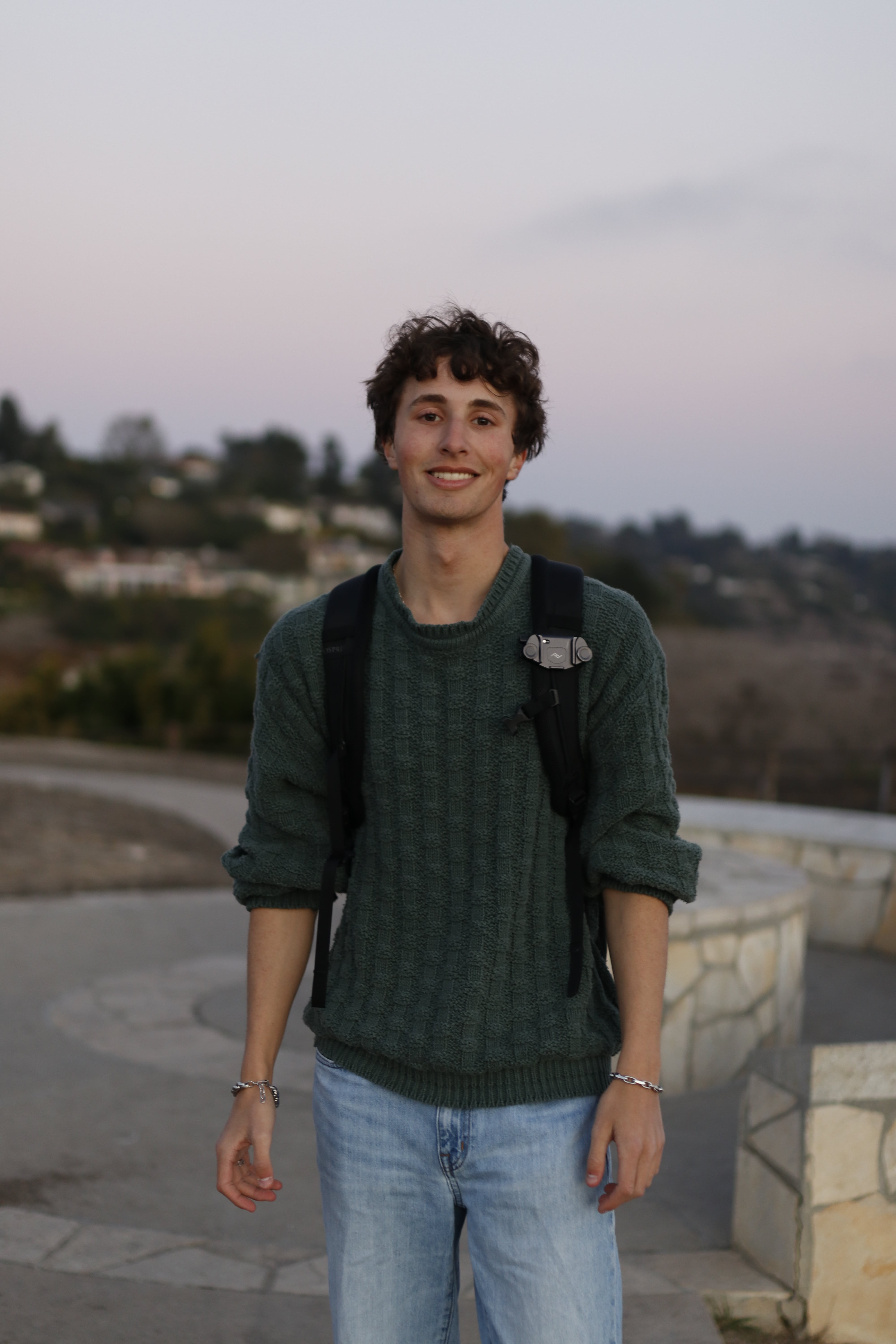
About
I am a senior physics major and 2026 Goldwater Scholar at UCLA pursuing theoretical research at the intersection of quantum field theory, gravity, and nuclear physics. My work at UCLA and the University of Tokyo uses powerful effective methods to connect fundamental theory with experimentally relevant problems, including next-generation gravitational wave and ultracold atom experiments. I have presented my research internationally and currently serve as a project coordinator in the European Research Council's GWSky collaboration. Alongside research, I am deeply committed to mentorship and accessibility in science, and I aim to carry these values forward as I pursue a career as an academic researcher and educator.
News
- Second paper now on arXiv! September 2026
- Nominated by UCLA for the Marshall and Rhodes Scholarships August 2026
- Named coordinator of the EFT for Environments project in the European Research Council's GWSky collaboration July 2026
- First paper now on arXiv! May 2026
- Accepted to 2026 IHES Summer School on Cosmological Correlators in France and UCLA URC-Sciences Summer Program; offered USTC Future Scientist Exchange Program in China May 2026
- See UCLA College Interview about winning the Goldwater Scholarship April 2026
- Won the 2026 national Goldwater Scholarship (1 of 2 UCLA students) March 2026
- Nominated by UCLA for national Goldwater Scholarship (1 of 4 at UCLA) January 2026
- FUTI Global Leadership Award Report available online December 2025
- UTRIP Archive and Final Report available online December 2025
- Attended GWSky Kick-off Meeting at Albert Einstein Institute (Germany) December 2025
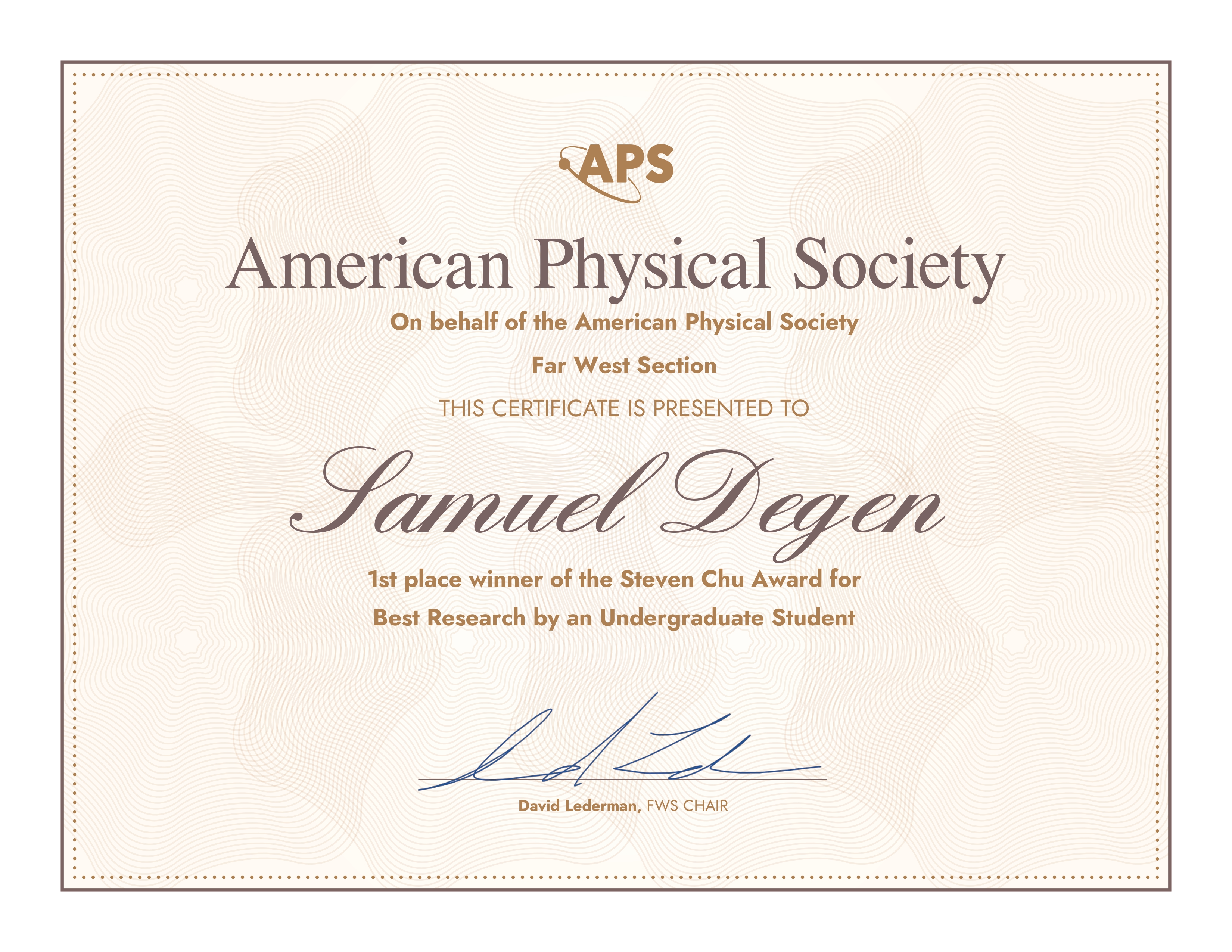
- Won 1st prize of APS Steven Chu Award for Best Undergraduate Research October 2025
Education
-
University of California, Los Angeles (UCLA)
- B.S. Physics 2023 – Present
- GPA: 3.988 overall; 4.0 major (16 graduate physics classes)
-
University of Colorado Boulder
- High School Concurrent Enrollment 2021 – 2023
- GPA: 4.0 overall
Publications
- Z. Bern, S. Degen, E. Herrmann, M.P. Solon and A.M. Wolz, “Environmental Effects in Post-Minkowskian Dynamics: Effective Field Theory, Feynman Rules, and Ward Identities for Compact Objects in Relativistic Fluids” 2609.20742
- S. Wang, S. Degen and H. Liang, “Functional methods for quantum thermodynamics” 2605.31112
Honors & Awards
2026
- Goldwater Scholarship — 1 of 454 students nationwide selected for outstanding potential for a research career in science, mathematics, or engineering (1 of 2 UCLA students) 26 - 27
- UCLA Nomination for Marshall and Rhodes Scholarships August
- UCLA URC-Sciences Summer Program — Selected as a full-time summer scholar supporting the proposal "Precision Modeling of Environmental Effects in Gravitational Wave Signatures" Summer
- (declined) USTC Future Scientist Exchange Program (FuSEP) — Offered participation for in-person fully funded research and culture program at the University of Science and Technology of China Summer
2025
- APS Steven Chu Award for Best Undergraduate Research (1st) — first place prize among all undergraduate research presented at the American Physical Society's 2025 meeting of the Far West Section (includes CA, NV, HI) October
- UCLA Undergraduate Research Scholars Program (URSP) — year-long research scholarship 25 - 26
- Mani L. Bhaumik Institute for Theoretical Physics Summer Research Fellowship — first undergraduate offered a summer research fellowship at UCLA’s Bhaumik Institute for Theoretical Physics August
-
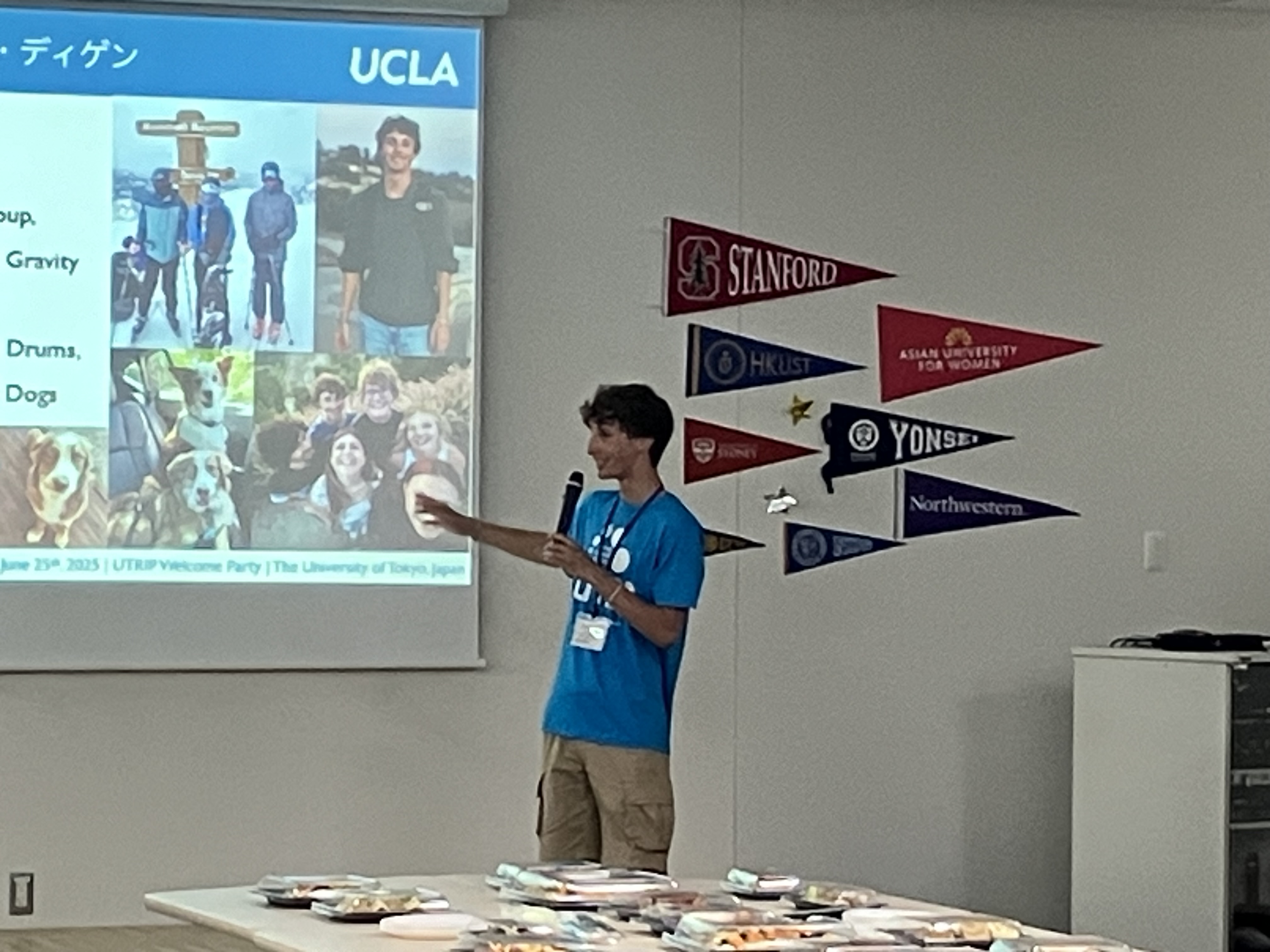
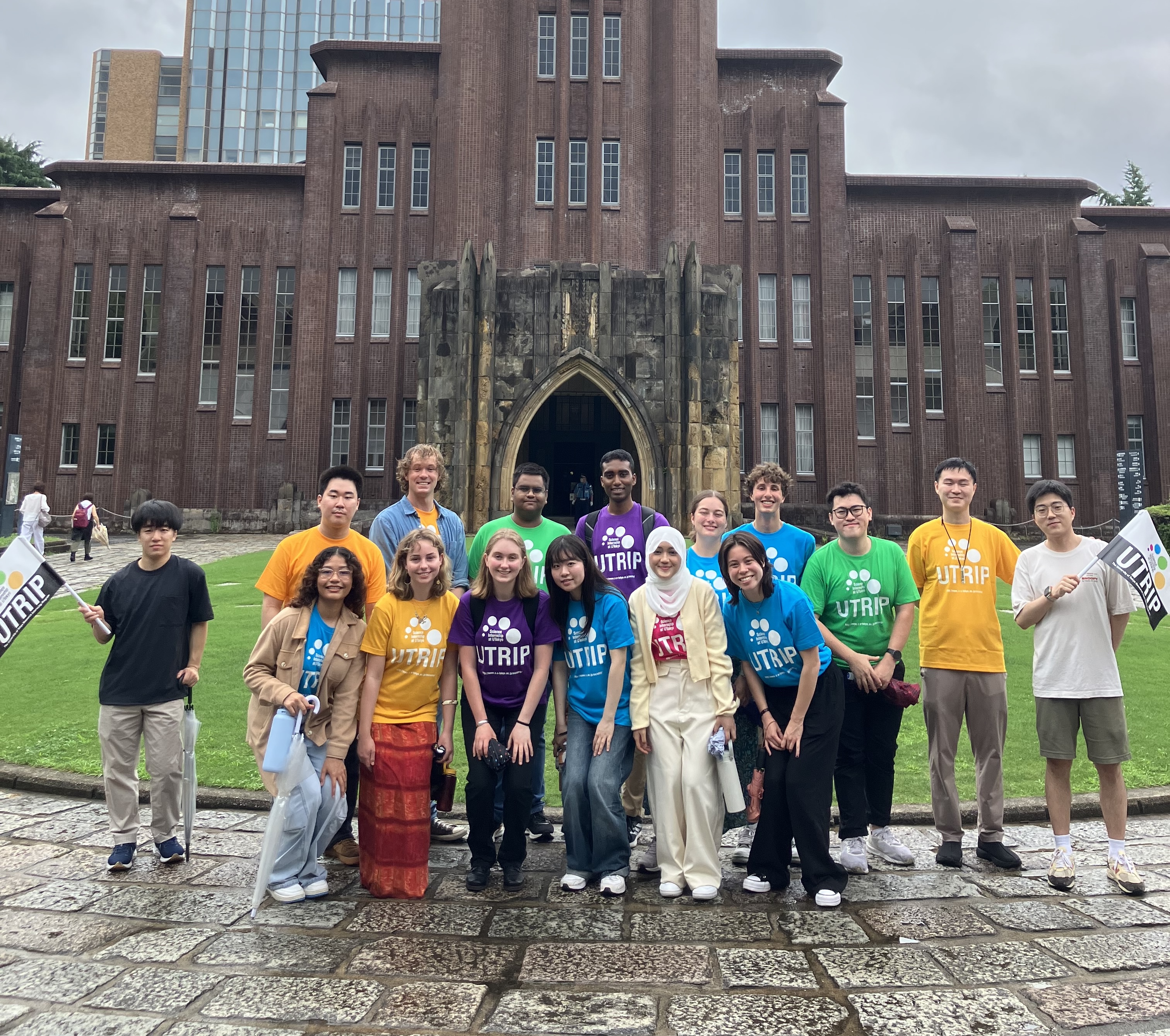
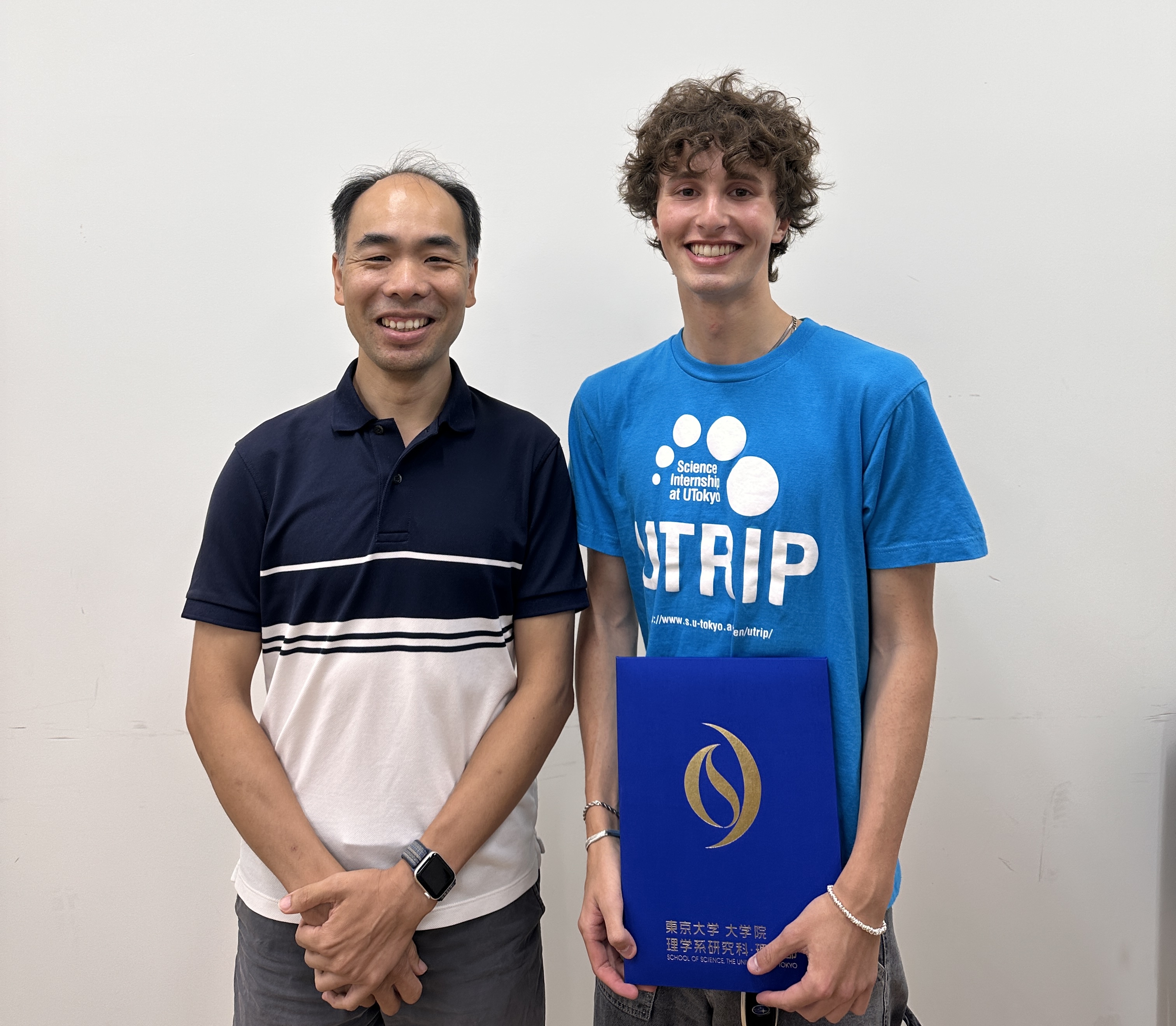
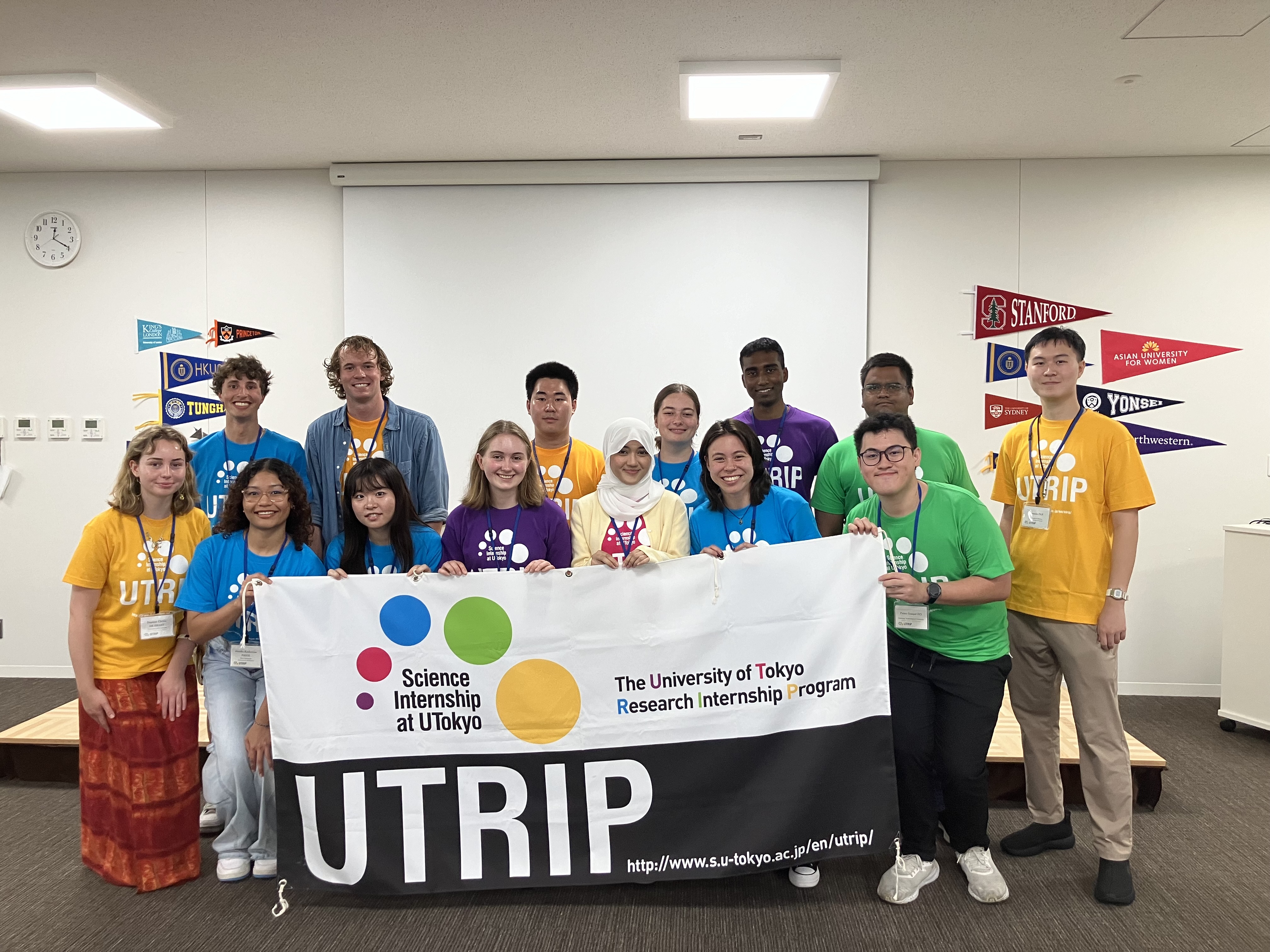
University of Tokyo Research Internship Program (UTRIP) — 1 of 14 selected from 1,149 applicants for in-person, fully funded research and culture program
June
- FUTI Global Leadership Award — 1 of 2 UTRIP students
- Perimeter Institute’s PSI START Satellite Program — 1 of 3 international students selected for in-person, fully funded 2-week program in theoretical physics coursework May
2024
- UCLA Summer Undergraduate Research Fellowship — 1 of 2 first-year undergraduates selected for competitive paid 10-week fellowship Summer
Research Experience
University of Tokyo — H. Liang Nuclear Theory Group 2025 –
present
- Applying functional renormalization group-aided density functional theory (FRG-DFT) to exactly solvable quantum many-body systems, with the goal of benchmarking nonperturbative first-principles approaches to nuclear density functionals.
- Deriving and truncating flow-equation hierarchies for ground-state energies and correlation functions, enabling controlled comparisons between FRG-DFT, perturbation theory, and exact thermodynamics.
- Developing numerical implementations to solve coupled flow equations and test the accuracy of approximate truncations across interaction strengths and densities.
- Co-authoring papers on benchmarking FRG-DFT against exact thermodynamics for the single-site Bose-Hubbard and Lipkin–Meshkov–Glick models, with broader applications to strongly correlated fermions and nuclear many-body theory.
- Presented related work at the University of Tokyo, APS Far West Section Meeting, and APS Global Physics Summit 2026; awarded 1st prize of the APS Steven Chu Award for Best Undergraduate Research for this project.
Supported by UTRIP 2025 and FUTI Global Leadership Award. Associated publication: arXiv:2605.31112 [cond-mat.quant-gas]
UCLA — Z. Bern & M. Solon Scattering Amplitudes Group 2025 –
present
- Developing a field-theoretic framework for environmental effects in gravitational-wave systems, with the goal of computing how surrounding media such as gas or dark matter modify compact-object dynamics.
- Formulating gravitational dynamical friction in hydrodynamic effective field theory as radiation into on-shell phonon modes, connecting classical drag forces to scattering-amplitude methods.
- Computing precision corrections to binary dynamics in non-vacuum spacetimes using perturbative QFT techniques, with attention to graviton-phonon interactions, gauge invariance, and Ward identities in a medium that breaks Lorentz symmetry.
- Drawing conceptual and technical connections between gravitational environmental effects and jet-quenching physics in QCD, where real-time propagation through a medium produces analogous dissipative phenomena.
- Youngest member and only undergraduate in the European Research Council's GWSky collaboration, contributing to a new international effort on precision theory for next-generation gravitational-wave astronomy; serving as a coordinator for the EFT for Environments project.
- Presenting this work at the GWSky Sexten Meeting, IHES Summer School, California Amplitudes Meeting, and UCLA Amplitudes Journal Club.
Supported by Mani L. Bhaumik Institute for Theoretical Physics Summer 2025 Research Fellowship, 2025 - 2026 UCLA URSP, and 2026 UCLA URCSSP. Associated publication: arXiv:2609.20742 [hep-th]
UCLA — E.P. Alves Plasma Theory Group 2024 –
2025
- Developed analytic and machine-learning methods to study time-dependent nonthermal particle acceleration in relativistic astrophysical jets.
- Formulated an inverse-modeling approach to distinguish physical acceleration histories from degenerate solutions that reproduce the same observed particle spectrum.
- Demonstrated limitations of simple energy-dependent acceleration models and identified more flexible time-dependent descriptions consistent with simulated jet dynamics.
- Presented results in an oral contribution at the 66th Annual Meeting of the APS Division of Plasma Physics.
Supported by UCLA Physics Summer 2024 Research Fellowship.
UCLA — B.C. Regan Condensed Matter Group 2024
- Developed an undergraduate-level pedagogical treatment of the Feynman checkerboard model, emphasizing its connection to propagators and relativistic quantum mechanics.
Selected Talks & Presentations
- “Synergistic Approaches to Precision Environmental Effects in Gravitational Waveform Modeling” (with Francisco Duque)
-
EFT for Environments Project Coordinators Report, GWSky Workshop, Sexten Center for Astrophysics Riccardo Giacconi; Sexten, Italy July 29, 2026
-
- “Progress on Computing the Dynamical Friction Force at next order in GN”
-
GWSky Online Monthly Meeting July 20, 2026
-
Flash Talks, GWSky Workshop, Sexten Center for Astrophysics Riccardo Giacconi; Sexten, Italy July 28, 2026
-
- “Gravitational Drag from Phonon Emission”
-
Amplitudes Journal Club, UCLA April 23, 2026
-
California Amplitudes Meeting 2026 (Davis), QMAP, UC Davis May 30, 2026
-
Cosmological Correlators Summer School Gong Show, Institut des Hautes Études Scientifiques (IHES), France July 10, 2026
-
- “Effects of Black Hole Environments on Gravitational Wave Signals”
-
California Amplitudes Meeting 2025 (LA), UCLA November 8, 2025
-
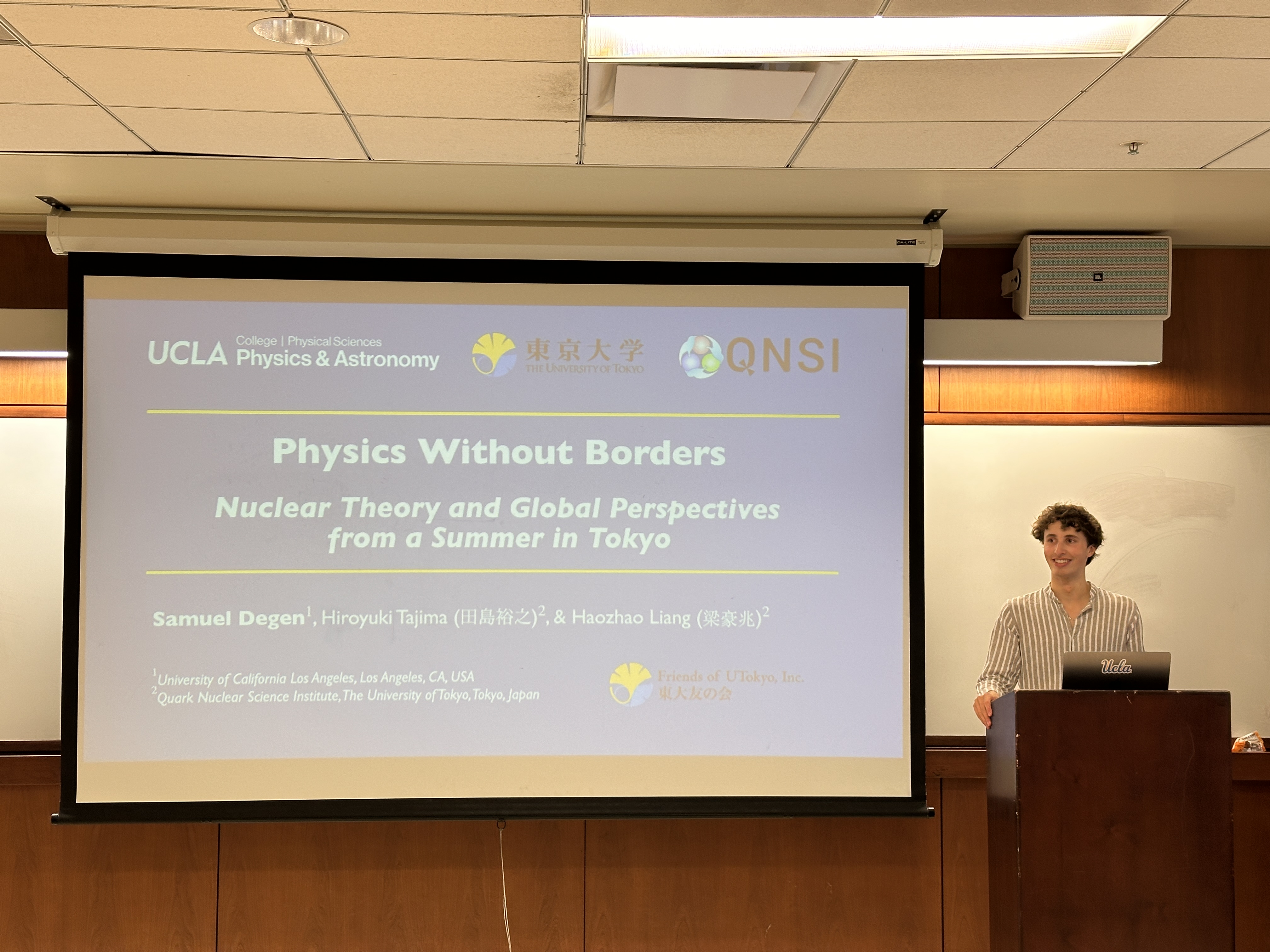
- “Physics Without Borders: Nuclear Theory and Global Perspectives from a Summer in Tokyo”
-
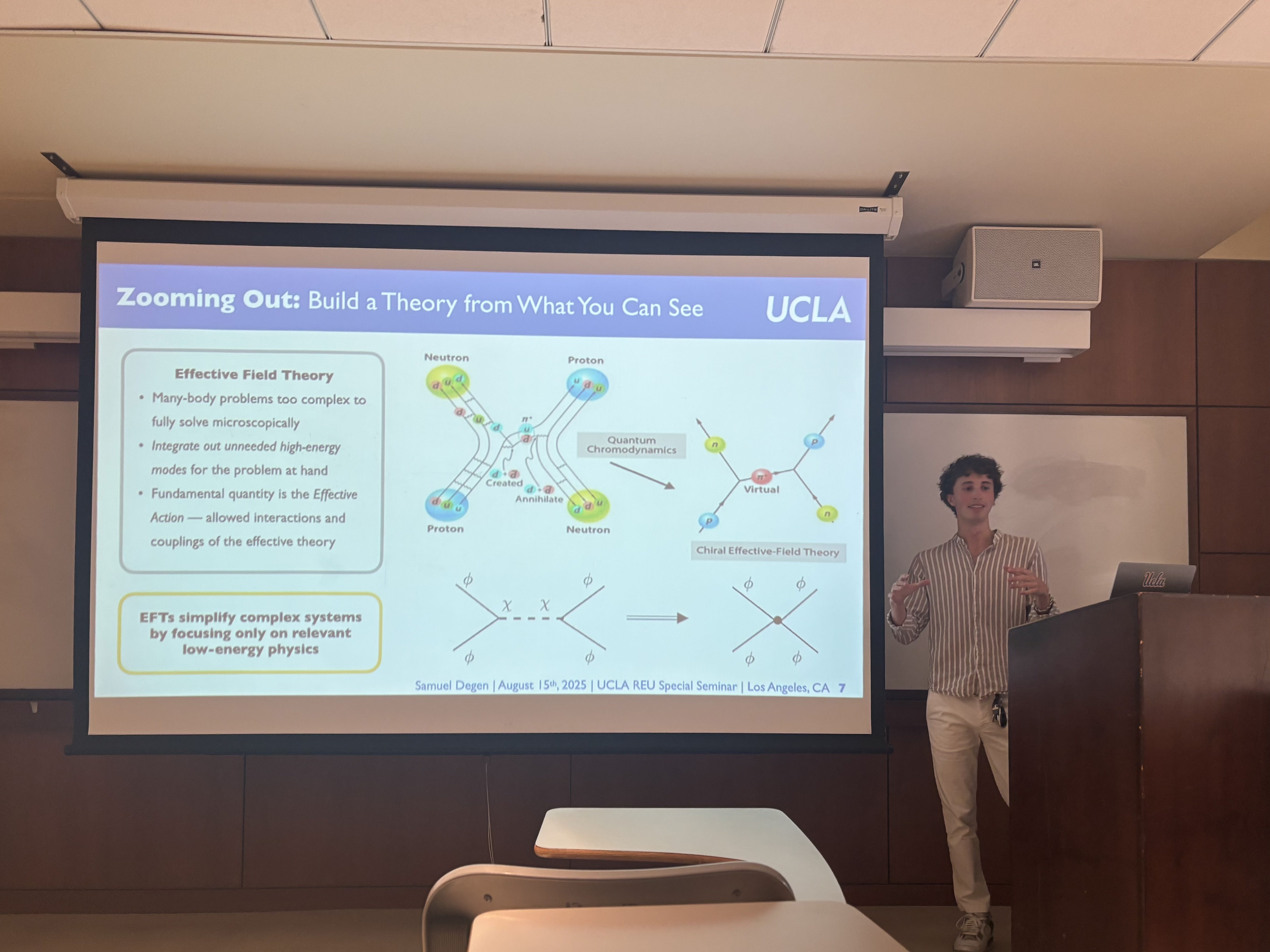
(invited) Research Experiences for Undergraduates (REU) Special Seminar, UCLA August 15, 2025
-
- “Benchmarking FRG-DFT with the One-Dimensional Fermi Gas – Towards a Nonperturbative Many-Body Nuclear Theory”
-
UTRIP Final Presentation, The University of Tokyo, Tokyo, Japan August 5, 2025
-
APS Far West Section, UC Santa Cruz (Steven Chu Award, 1st) October 11, 2025
-
APS Global Physics Summit, Denver, Colorado March 17, 2026
-
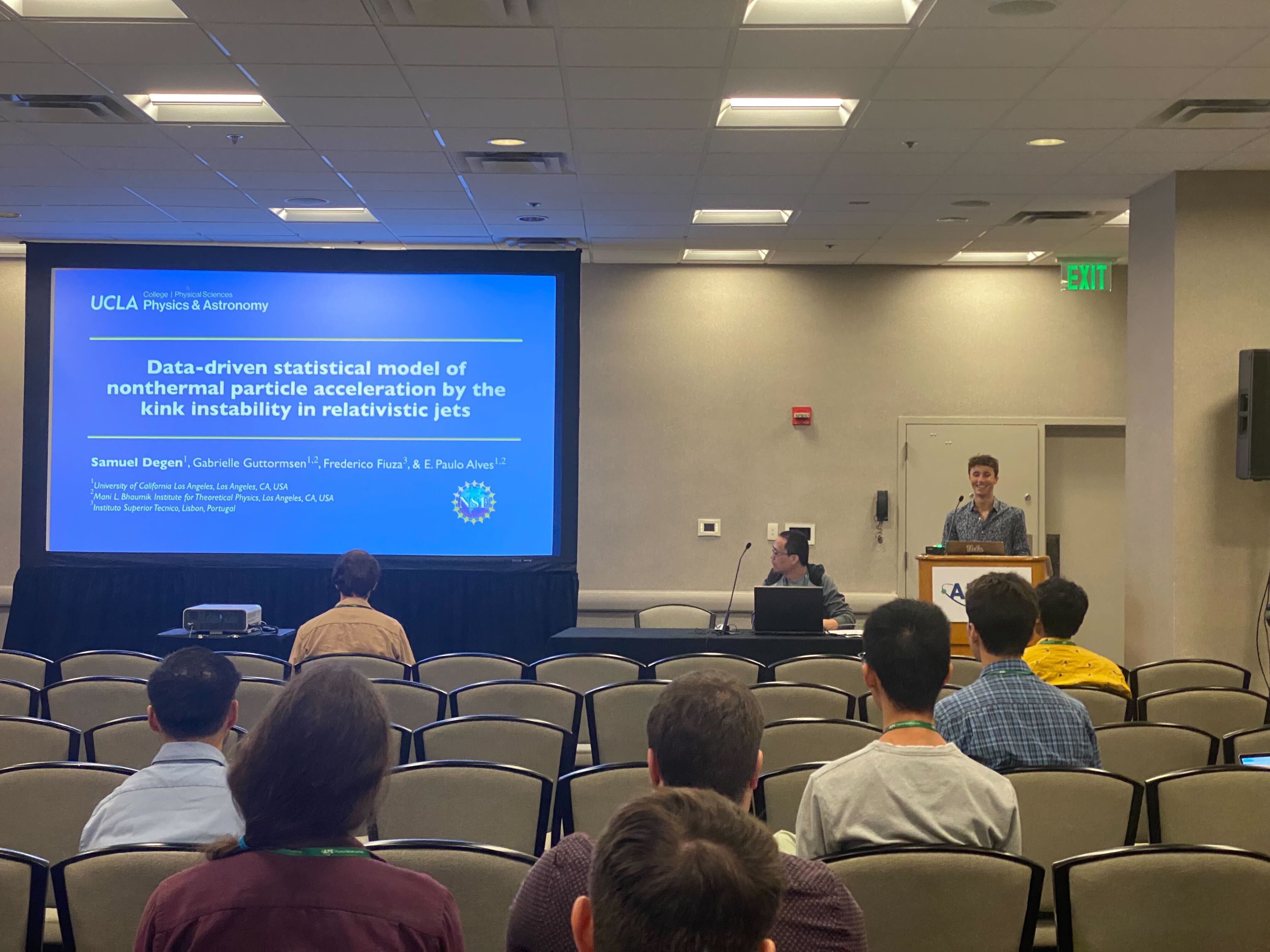
- “Data-driven statistical model of nonthermal particle acceleration by the kink instability in relativistic jets”
-
APS Division of Plasma Physics, Atlanta, Georgia October 9, 2024
-
- “From Finite Groups to Lie Algebras: Symmetries and Representations in Physics”
-
Perimeter Institute PSI START Program, Bishop’s University, Sherbrooke, Quebec, Canada May 29, 2025
-
Meetings Attended
- GWSky Workshop - Precision Gravitational Wave Astronomy: From Theory to Discovery — Sexten Center for Astrophysics Riccardo Giacconi, Italy July 2026
- 2026 IHES Summer School - Cosmological Correlators — Institut des Hautes Études Scientifiques (IHES), France July 2026
- California Amplitudes Meeting 2026 (Davis) — Center for Quantum Mathematics and Physics (QMAP), UC Davis May 2026
- APS Global Physics Summit 2026 — Denver, Colorado March 2026
- Accelerating Math and Theoretical Physics with AI — Institute for Pure and Applied Mathematics (IPAM), UCLA March 2026
- GWSky Kick-off Meeting — Max Planck Institute for Gravitational Physics (Albert Einstein Institute–AEI), Potsdam, Germany December 2025
- California Amplitudes Meeting 2025 (LA) — Mani L. Bhaumik Institute for Theoretical Physics, UCLA November 2025
- 2025 Annual Meeting of the APS Far West Section — UC Santa Cruz (Steven Chu Award, 1st) October 2025
- 2025 Southern California Strings — Mani L. Bhaumik Institute for Theoretical Physics, UCLA October 2025
- California Amplitudes Meeting 2025 (Davis) — Center for Quantum Mathematics and Physics (QMAP), UC Davis May 2025
- 66th Annual Meeting of the APS Division of Plasma Physics — Atlanta, Georgia October 2024
Service & Outreach
Interviews & Press
- 2026 Goldwater Scholarship ( UCLA College Interview ) March 2026
- APS Steven Chu Award for Best Undergraduate Research October 2025
- FUTI Global Leadership Award August 2025
- University of Tokyo Research Internship Program ( final report ) June 2025
- Perimeter Institute’s PSI START Satellite Interview May 2025
Activities
- Guest Lecturer (upcoming October 2026), UCLA Olga Radko Endowed Math Circle (ORMC) — invited to deliver a lecture on theoretical physics to 400+ gifted pre-college mathematics students, communicating advanced ideas to a non-specialist audience
- Peer Mentor, Division of Physical Sciences, UCLA — provided first-year physical science students guidance on coursework, professional development, fellowships, and early research opportunities, especially for those interested in theoretical physics
- Professional Events Chair, Society of Physics Students, UCLA — developed resources for research and course planning
- Teaching Assistant Training, Department of Physics & Astronomy, UCLA — only undergraduate trained as TA; appointments pending improved department funding
- Member, Amplitudes Journal Club, String Theory Journal Club, Plasma Theory Journal Club @ UCLA